
Your first session
Your first AutoMode session in Claude Code: a question runs on Haiku, an edit on Sonnet, risky work on Opus with a review. Read the bar and steer a prompt.
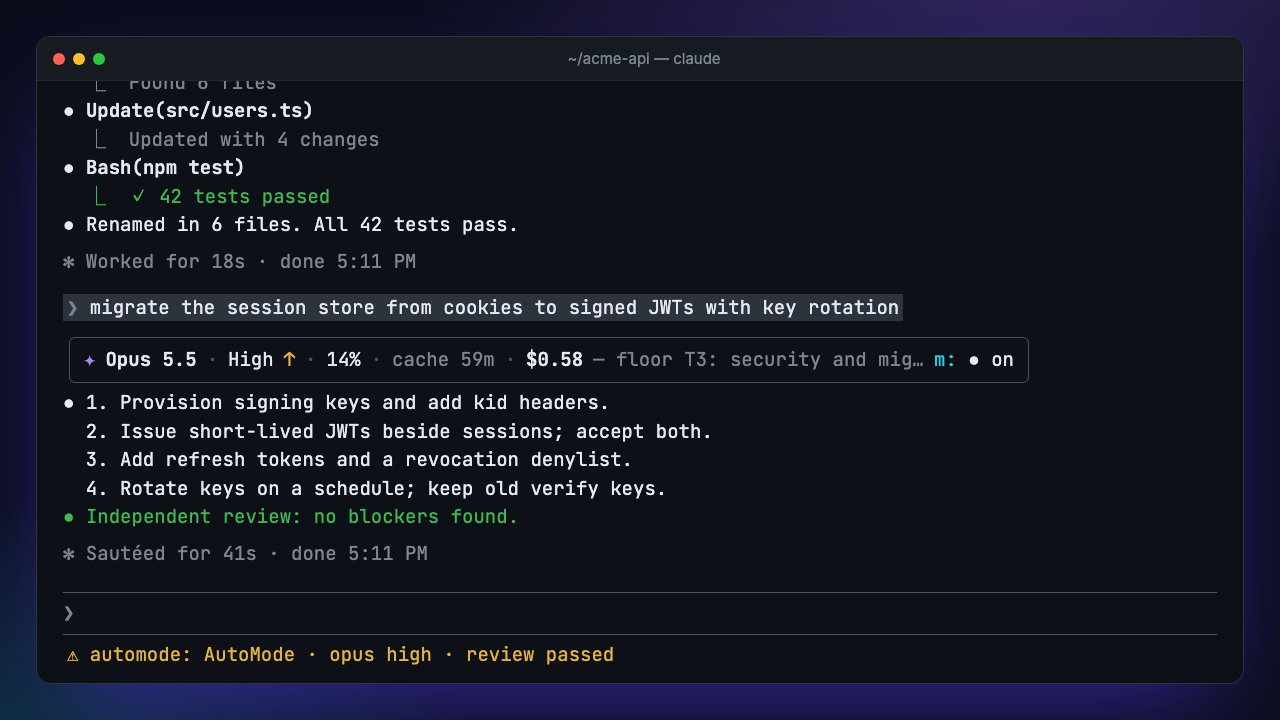
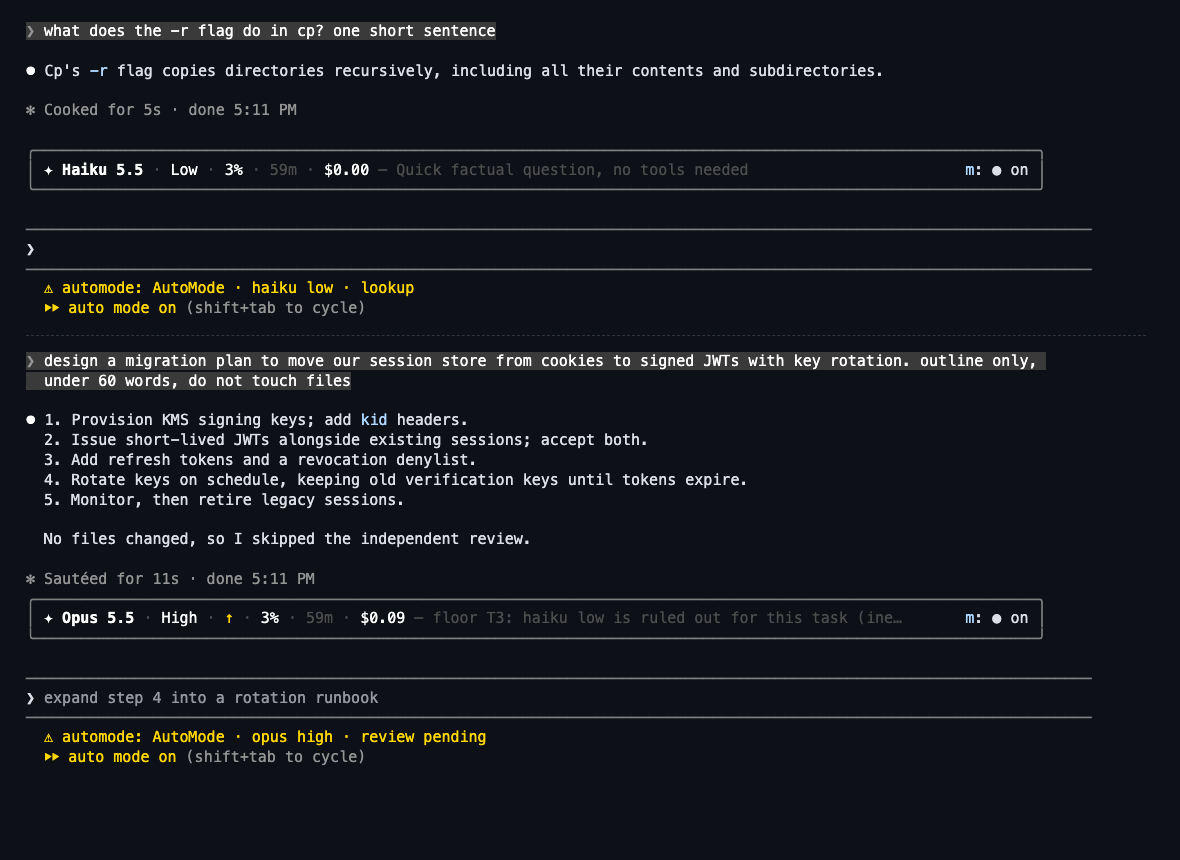
You do not change how you work. Type prompts as usual. AutoMode decides the model and the effort before each one runs, and the bar above the prompt shows what it chose.
Ask a quick question
Try What does the --frozen-lockfile flag do?. The bar shows Deciding… for about a second, then Low · Haiku. A question needs facts, not deep thought, so it runs on the cheapest model.
Ask for a small change
Try Rename getUser to fetchUser across the package. It runs on Sonnet at the effort the judge picks. Sonnet must show a passing test or build before it says done.
Ask for something risky
Try Migrate the session tokens from HS256 to RS256. That matches the security rules, so a quality floor rules out Haiku. After the checks pass, an independent reviewer reads the diff. It runs on Opus when the diff shows critical risk.
Ask for open-ended work
Start the prompt with am:run, such as am:run add rate limiting to the public API. That runs the workflow: discover, plan, build, verify and review, with six small agents.
Steer one prompt
Start a prompt with an am: command to override the route for that prompt only.
| You want | Type |
|---|---|
| A stronger model | am:opus or am:sonnet before the prompt |
| More or less thinking | am:low, am:medium, am:high, am:xhigh or am:max |
| No workflow | am:direct <request> |
| The workflow | am:run <request> |
| Back to automatic | am:reset |
Your own /model and /effort choices count too. AutoMode treats them as a pin and keeps them. See Prompt commands.
See what it did
/automodeprints the bar as text, with the reason for the route./automode detailsadds the workflow stages, the guardian and usage./automode:usagelists model calls, tokens, cache use and the estimated API cost of the session.
Last updated on
Install AutoMode
Install the AutoMode mod for Claude Code in about a minute: ask Claude, type two chat commands, or run one terminal line. Needs Claude Code 2.1.287+.
Where AutoMode runs
Where AutoMode routing, the guardian and the bar run: the terminal, the Desktop app, VS Code, claude -p, the Agent SDK, and each API provider.